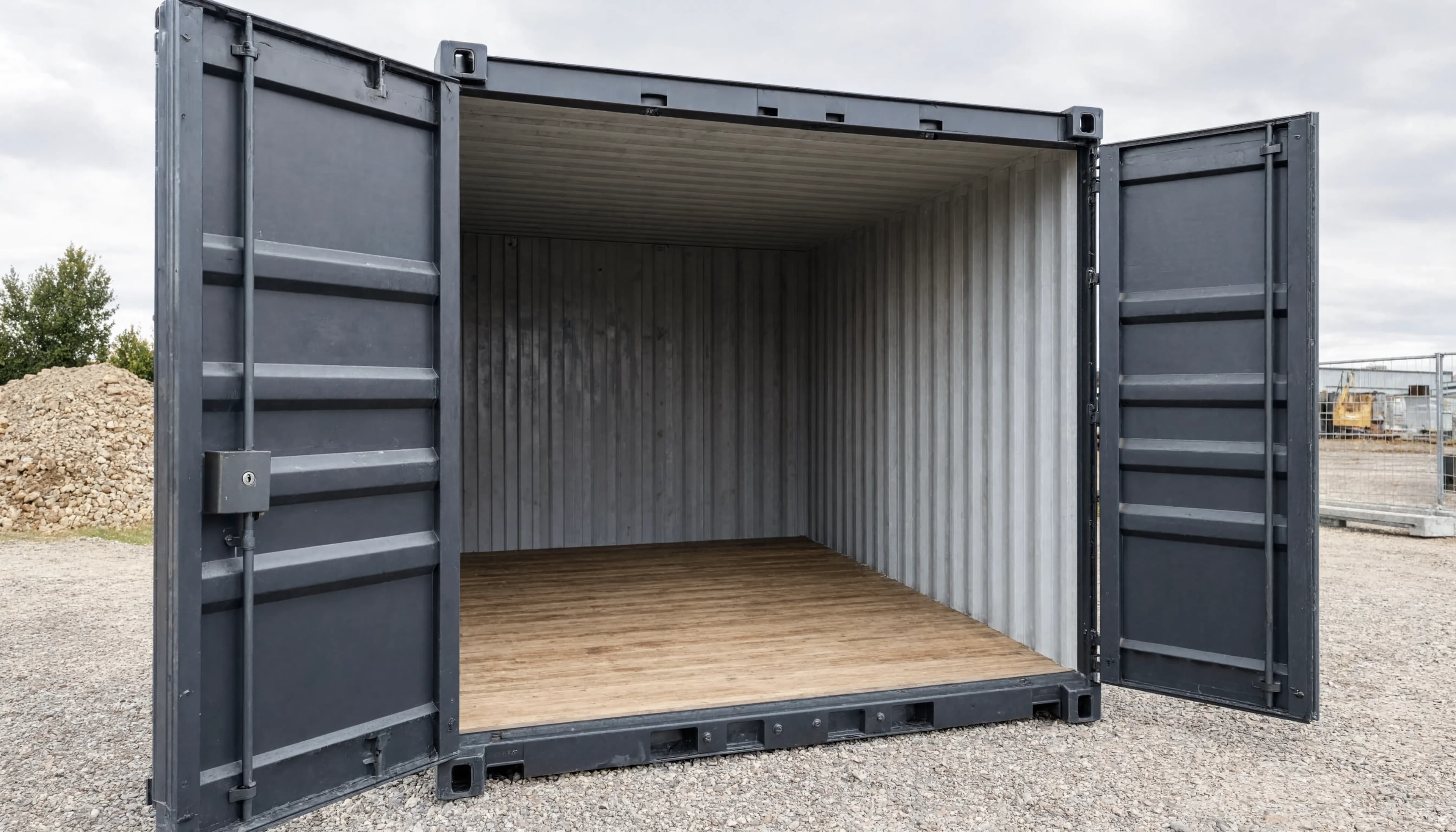
Storage container rental can keep furniture, equipment or stock at your premises. Choose a container delivered to your site, or self-storage where you take your goods to a provider's premises. Compare the size, access and total cost for your dates and ZIP code.
Generated illustrative image
Compare the storage you need.
At home or in a depot, services differ. Ask for details on transport, access to your goods and end-of-rental charges to compare offers on the same basis.
Independent supplier matching · Free for the requester
Start with your delivery area, then compare the rental period, container size and full transport cost. A nearby business contact may arrange equipment from another location: ask which yard supplies your unit and whether it can deliver to your property's ZIP code.
Give each company the same dates and delivery ZIP. Compare billing periods, minimum charges, extensions, delivery, unloading and return collection. Keep any refundable deposit separate from the rental cost.
Storage container rental on your site or self-storage?
With delivered rental, you arrange a suitable location for the container on your land. With depot self-storage, the container stays at the provider's premises. Decide which arrangement suits your goods and how often you need access before requesting quotes.
A container delivered to you
On your ground or site
Your goods stay close to where you use them. Plan the container location, truck access and door opening.
Get quotes for delivery, unloading and collection.
Rental rates are quoted by the provider for the size, dates and location you need; this page does not publish a verified US rental price sample. For a delivered container, give your ZIP code and site access details. A container purchase price does not describe a monthly storage service.
For delivery to your site, itemize rental, outward and return transport, lifting, positioning and any cleaning or repair charges. For depot storage, itemize the space, access terms, transport of your goods, insurance and any administration charges. Request the total including applicable sales tax and confirm the minimum charge and notice period.
Choose the size with your goods, then check the doors.
Measure the bulkiest items and estimate the packed volume. Keep space to access goods you will need to retrieve during the rental.
20ft standard
1,172.4 cu ftTypical internal volume, before storage
For storing furniture, equipment or stock. Keep a walkway if you need to retrieve items regularly.
40ft standard
2,390.8 cu ftTypical internal volume, before storage
For a larger need. Check available space and loading organization along the whole length.
40ft High Cube
2,694.5 cu ftTypical internal volume, before storage
To add height. Check door clearance and the height of items, including packaging and support.
The geometric volume is not fully usable once furniture, packaging and walkways are added. For a compact size, side opening or special dimensions, choose 'Other size' and describe your needs.
Useful dimensions: footprint, interior and door opening.The dimensions to check what will fit and prepare the container location.ExpandCollapse
T1Reference points for 20ft, 40ft and 40ft High Cube sizes.
Dimension
20ft Dry1CC / 22G1
40ft Dry1AA / 42G1
40ft High Cube1AAA / 45G1
Status
External lengthDetermines the footprint and transport size.
19 ft 10.5 in
40 ft
40 ft
ISO reference
External widthIdentical across Series 1, regardless of length.
8 ft
8 ft
8 ft
ISO reference
External heightThe only thing 'High Cube' means: 1 ft more.
8 ft 6 in
8 ft 6 in
9 ft 6 in
ISO reference
Door opening widthCheck the clear door opening against the load and handling equipment; it can be smaller than the internal width.
7 ft 8.1 in
7 ft 8.1 in
7 ft 8.1 in
typical
Door opening heightConfirm the clear door height before loading; sufficient internal height alone does not establish that an item will pass through the doors.
7 ft 6.2 in
7 ft 6.2 in
8 ft 6.2 in
typical
Internal volumePublished volume for the fleet example, before stowage and securing.
1,172.4 cu ft
2,390.8 cu ft
2,694.5 cu ft
typical
Internal floor areaRounded from the reference internal dimensions above.
149.6 sq ft
304.6 sq ft
304.6 sq ft
typical
ISO reference — confirm the full standard, tolerances and actual unit specificationtypical — varies by manufacturer and ageto note
Display conversions are rounded; confirm the original specification before fabrication or loading.
ISO reference values: public standard metadata was checked; the full normative text and tolerance tables were not reviewed. Confirm the applicable specification before fabrication or loading.
Interior dimensions, floor area, volume and openings are typical reference points. Request the specification sheet for the model offered, taking into account any modifications.
The shaded area is the door opening: it is what determines what fits, not the volume. It loses little in width — 7 ft 8.1 in against 7 ft 8.6 in inside — but less clearance in height, 7 ft 6.2 in against 7 ft 10.3 in. A load that fits within the volume but exceeds the lintel remains on the quay. Scale drawing, traced over the dimensions in the table below. External length: 19 ft 10.5 in; width: 8 ft; height: 8 ft 6 in. Display conversions are rounded.
Door clearance must be checked with the item, its packaging and handling equipment. For heavy equipment or racking, ask for the allowable load and its distribution on the floor.
The budget to compare for the whole duration.
Request a total with the same dates, the same size and the same services. Ask for a distinction between included services and additional costs.
Container on your site
Rental charges + return transport + unloading and siting + options and end-of-rental services.
Describe the address, access and location. Ask about billing dates, extension rate and cleaning, repair or site restoration terms.
Container in a depot
Rental charges + transport of your goods + optional services and insurance to be confirmed.
Confirm access, minimum billing period, notice period and any admin or exit fees. Also allow for journeys needed during the rental.
Manage the deposit separately: it is a cash advance if refundable, not necessarily a final cost. Check the return conditions.
For delivery, send a few photos.
Show the gate, bends, height obstacles and desired location. Have the vehicle access, handling, supports and door clearance validated by the relevant parties.
Furniture, boxes, equipment: specify what you are storing.
Describe goods sensitive to moisture, temperature or dust. The supplier will be able to specify the container features and suitable equipment.
Check the condition before loading
Ask for a clean interior, suitable floor and working doors. On handover, note the condition, seals and any signs of water ingress with the rental company.
Define storage conditions
A standard container does not guarantee controlled temperature or humidity. Specify winter freezing, summer heat and moisture limits for your goods so that any insulation, heating, ventilation and monitoring can be designed for the actual climate and use. Insulation alone does not maintain a temperature.
Watertightness and condensation: two points to distinguish.A container that is rainproof can still have interior condensation.ExpandCollapse
Condensation depends mainly on the humidity present and temperature variations. Ask for details on the measures planned for your goods and their monitoring during storage. Ventilation, insulation and moisture absorbers address different situations; no single piece of equipment proves that sensitive goods will be kept in the right conditions.
Locking, access and insurance: ask for clarification on protections.
Tailor the request to the value and nature of the stored goods.
Container locking: padlock provided or to be arranged, lock box and key management.
Site access: opening hours, entry control and vehicle access conditions.
Advertised surveillance: equipment, services and limits to be specified in the contract.
Insurance: goods covered, declared value, exclusions, excess and documents required.
Check that the contract covers your goods and the intended use. A 'secure' mention alone does not specify the insurance cover.
Fuels, chemicals and gas cylinders need a separate assessment
Do not treat an ordinary steel storage container as an approved chemical store. Before booking, disclose fuels, aerosols, gas cylinders or other hazardous goods and check the provider’s restrictions. Give the assessor the product safety data, quantities and proposed handling; a lock and ventilation grilles alone do not establish a safe arrangement.
Assess hazardous products before use: compatibility, leaks, ventilation, ignition sources, fire spread, spill control, emergency procedures and safe access. Review the safety data sheets, applicable OSHA Hazard Communication requirements for labels, the written program and employee training, local fire code and applicable workplace and environmental rules. A standard shipping container is not automatically an approved chemical store. This page establishes no universal storage quantity or separation distance.
Container or self-storage unit? Compare the use.
A container located in a depot is itself a form of self-storage. To compare with a unit inside a building, look at the practical conditions of use.
Accessing your goods
Opening hours, parking, distance between vehicle and rented space, any floor level and handling equipment.
Storing in good conditions.
Useful dimensions, height, opening, moisture protection and conditions suitable for your goods.
Controlling the cost.
Rent over the planned period, transport of goods, services, insurance, notice period and entry or exit fees.
There is no volume or duration that makes one option systematically cheaper. Compare offers for the same contents and period.
The right space, in the right place.
On your site or at a depot: describe your needs to compare storage offers. Free and with no obligation.
Request a quote for the storage location, size and dates. No verified US storage rental price is published on this page. On-site delivery and depot storage involve different services: compare totals including applicable sales tax, transport, access, insurance and end-of-rental charges.
What is the difference between on-site rental and depot rental?
On-site, the container is delivered to your land or business premises: you need to prepare the location and get costs for delivery, handling and collection. At a depot, the container remains at the storage center: you bring your belongings there and use the access provided by the center.
What size should you choose for storing the contents of a house?
Make an inventory, estimate the packed volume and measure the bulkiest items. Add the access needed to reach your belongings during the rental. The number of rooms in a house is not enough to choose a size; ask the supplier to confirm the possible storage layout and door clearance.
Can I rent for less than a month?
Check the minimum rental period and billing period with the supplier. In the form, enter one month and then give your actual dates in the inquiry.
Does a watertight container protect against all moisture?
No. Rain tightness and internal condensation are two different things. A standard container does not guarantee controlled humidity or temperature. Describe your belongings and ask the supplier to specify the storage conditions and equipment needed.
Can you access a depot container at any time?
It depends on the center and its contract. Confirm opening hours, key or entry arrangements, vehicle access, loading conditions and any appointment requirements. Do not assume 24-hour access unless it is included in your agreement.