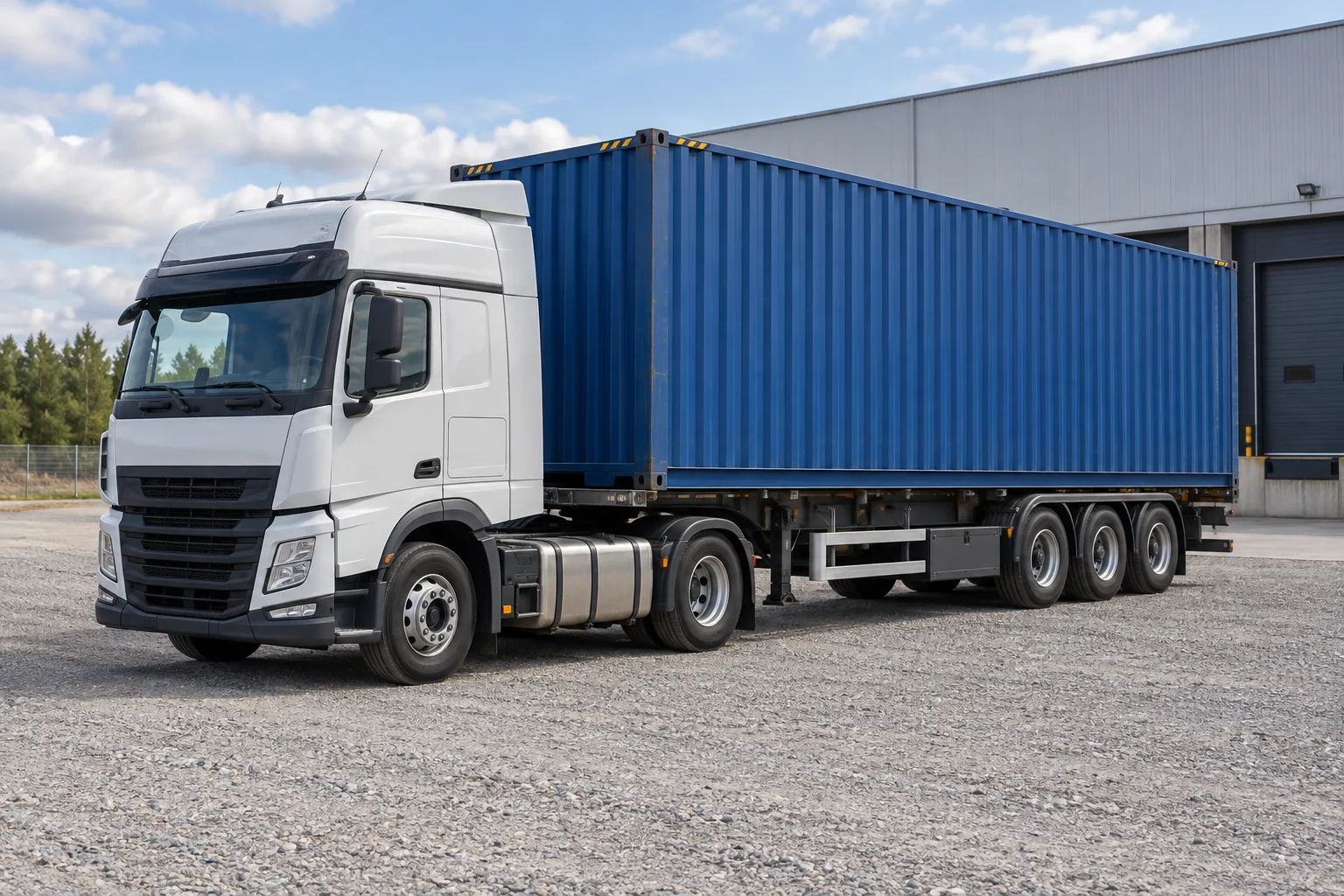
Shipping container delivery in the USA: transport and unloading
Compare the full cost of a shipping container delivered and unloaded where you need it. Describe the access and final position, then ask for the container, road transport and unloading to be priced separately.
Three items to compare
1
Container specification for delivery
Type, condition and quantity. For rental, duration, rental and invoiced dates.
2
Transport to your delivery site
Departure from the depot, arrival address, route and vehicle access conditions.
3
Unloading the container at your site
Lifting method, drop-off position and placement services.
AI-generated illustration. An example scene, not a photograph of a container for sale or a specific supplier.
How much does shipping container delivery cost?
Shipping container transport cost depends on the departure depot, delivery ZIP code, container and unloading method. Request a quote for those details; this guide does not publish a flat US delivery tariff.
Ask for an itemized delivered quotation.
State the number, size and loaded or empty weight of the containers. Ask the supplier to identify transport, lifting, positioning, sales tax and any waiting, access or return charges separately.
The route, access and lift plan affect the price. Assess the complete loaded truck, including chassis and equipment, rather than the shell alone. Federal size and weight rules apply to specified highway networks and vehicle configurations; states issue oversize or overweight permits, with local route restrictions also relevant. There is no federal vehicle-height limit: verify state limits, bridges, overhead obstructions and the approved route. The carrier must confirm the applicable securement arrangement, including 49 CFR 393.126 for covered intermodal-container transport. A road permit does not approve site lifting. Ask for permit, escort and unloading charges separately.
Who unloads the container on arrival?
State from the outset whether you have on-site handling equipment. The professional must confirm the vehicle and equipment suited to the weight, access and final position.
Ground-level delivery
Tilt-bed or roll-off delivery
The truck or trailer tilts to slide the container onto the prepared position. This method needs a clear, straight unloading approach, overhead clearance during tilting and room for the vehicle to leave. Ask the carrier to confirm its exact space and ground-support requirements.
To be confirmed: unloading direction, clear approach and door orientation.
To be arranged with the supplier
Crane truck delivery
The vehicle transports the container and lifting equipment handles the unloading. Ask for clarification on the possible position of the truck and the reach required.
To be confirmed: working space and final position.
Services to coordinate
Separate transport and crane
The carrier brings the container; an equipped contractor handles the lifting. Have the requirements validated and the schedules of the two services coordinated.
To be confirmed: who books and invoices the lifting.
You take care of the unloading
Equipment already on site
Describe the available equipment and its operator. Its presence is not enough: its suitability for the container and the operation must be confirmed.
To be confirmed: capacity and handling method.
Delivery to the gate and placement at the chosen location do not cover the same service. Have the expected drop-off point written into the quote.
Agree who plans and supervises lifting for the actual load, reach, rigging, ground conditions and exclusion area. Confirm the qualifications, equipment inspections and records required for that operation with the lifting contractor. For construction cranes within OSHA Subpart CC, address ground support under 1926.1402 and the applicable power-line provisions: 1926.1408 covers equipment operations up to 350 kV, with 1926.1409 applying above 350 kV. Closer approaches and traveling with no load have separate provisions under 1926.1410 and 1926.1411. Have the contractor establish the required precautions for the actual operation and voltage; there is no single clearance for every situation. Confirm federal OSHA or State Plan coverage and whether the equipment and activity fall within those provisions. Obtain any site, lane-closure or public-road permissions separately.
The carrier must verify vehicle-plus-load dimensions, gross and axle weights, securement, the route, seasonal restrictions and permits in each jurisdiction crossed. A CSC plate is not a road-payload approval. Confirm the actual load and handling method before work starts.
Four site details for preparing your delivery
Prepare this information before contacting the supplier. A few photos and measured dimensions will help them assess the delivery; access and support conditions still need to be confirmed by those involved.
01
The entrance
Photograph the gate and note its usable dimensions. Indicate access times and any known restrictions.
02
The truck route
Show bends, slopes, narrow passages and overhead obstacles between the street and the drop-off point.
03
The unloading area
Identify the possible vehicle position, the space available around it and the distance to the desired location.
04
The final location
Show the ground and the planned supports. Indicate the direction the doors open and the space to keep clear for using them.
The container footprint is not enough.
Also allow for vehicle arrival and exit, the lifting work area and door opening. The required width depends on the truck and handling method chosen: have your case checked before scheduling the delivery.
Check the terms of the offer. Request a total that separates the container, transport and unloading. A price quoted from a depot is not enough to know the cost at your address.
Does the truck always unload the container?
Unloading must be explicitly arranged. Depending on the offer and site conditions, it may be carried out by an equipped truck, by another lifting provider or by suitable equipment already on site.
What width is needed to get the truck in?
This depends on the vehicle selected and the maneuvers required. Record the gate dimensions, turns, obstacles and space near the placement point, then have the transport provider confirm the access.
What should be planned for collecting a rented container?
Have the return and collection costed from the initial quote. Confirm the return conditions and keep the access required for collection at the end of the rental.
I already have a container: does this form allow me to book its transport?
This form prepares a request to buy or rent a container with delivery. To move a container you already own, check the activities and contact details of businesses in the supplier directory to find a suitable contact.