Budget for refrigerated storage · USA guide
Refrigerated container electricity costs: measure, calculate and compare
A refrigerated container has no single reliable daily electricity cost. Start with evidence for the actual equipment and operating duty, then apply your tariff over a stated number of days. The calculator keeps measured consumption separate from a power assumption and does not supply an invented average for a 20ft or 40ft unit.
Reviewed
By the ContainerFox editorial team. Research, limits and corrections.
Read the plain-text guide (Markdown)
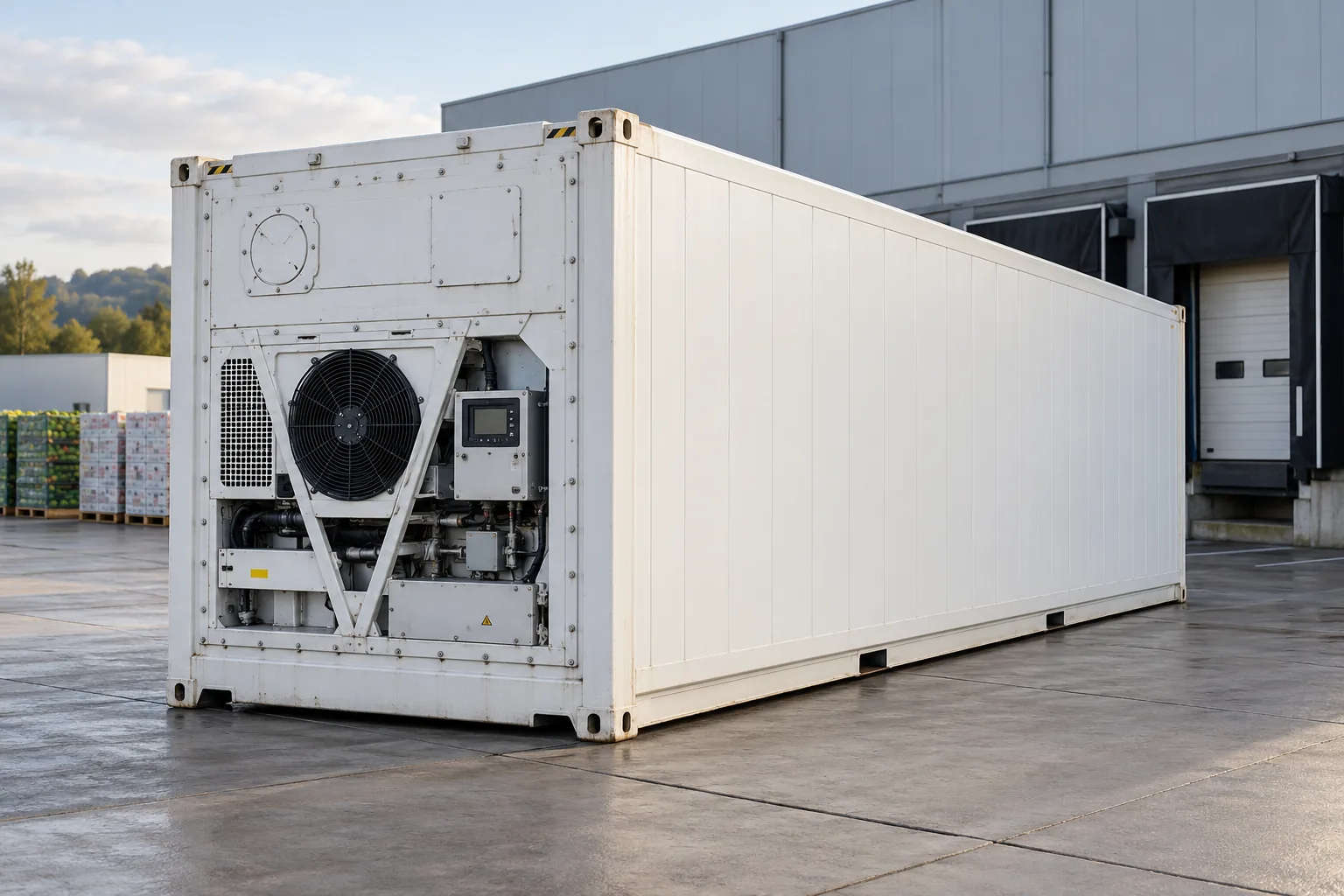
Electrical power, energy and cooling capacity are different
Electrical power in kilowatts (kW) is the rate at which equipment uses electricity. Energy in kilowatt-hours (kWh) is the amount used over time. An average electrical demand of 2 kW over 3 hours represents 6 kWh; a brief 2 kW reading does not establish that the equipment averaged 2 kW for the whole period.
Cooling capacity may also be stated in kW, but it describes heat removal rather than electricity drawn from the supply. A cooling-capacity figure cannot be entered as electrical consumption. Similarly, a maximum connection rating or a starting current is not the unit’s average running demand.
| Number | Useful for | Not sufficient for |
|---|---|---|
| Measured kWh with start/end times | Costing the observed period and making an explicit projection | Predicting every future load or season |
| Average electrical kW over a defined duty | Estimating kWh for a stated number of powered hours | Selecting cable, protection or generator size |
| Cooling capacity in kW | Assessing the refrigeration duty with the supplier | Calculating the electricity bill directly |
| Electrical nameplate and connection specification | Preparing the actual supply with a qualified electrician | Establishing typical daily kWh |
Your figures · USD · calculated in this page
Estimate electricity cost from your own data
Blank means unknown. Enter 0 only for a confirmed zero or a cost included elsewhere. Money accepts up to two decimal places, without thousands separators, from US$0 to US$1,000,000 per entry. Use a dot or comma decimal. All costs in each section must have the same sales tax basis and rate; otherwise obtain inclusive totals first. No assumption is made about sales tax recovery.
Amounts are calculated in cents. The energy charge is rounded to the nearest cent, then any sales tax is rounded on the section total; invoice line-by-line rounding may differ slightly.
Electricity scenario
Projected energy: Incomplete.
Energy charge on the entered sales tax basis: Incomplete
Electricity plus entered supply charges, including sales tax: Incomplete
Still unknown: Projected days, Powered hours per day, Electricity price per kWh, Other supply charges for the project, sales-tax basis, Measured kWh, Measurement hours.
Projection assumes the same operating conditions and average use. It does not size a connection, generator, cable or refrigeration system. A qualified electrician and supplier must check the actual installation.
Keep or edit your scenario
The summary is limited to 1,200 characters. Unknowns stay visible. Copy or download it, or add it to the quote form and edit it before sending. No request is sent by this tool.
Try it: a recorded energy total projected to the same duty
Hypothetical demonstration. These inputs are chosen to explain the calculation; they are not a supplier quote, field test or inspection.
Choose measured energy, enter 240 kWh over 72 hours, 14 projected days and 24 powered hours per day. Enter $0.2375 per kWh and $14 other supply charges, using final tax-inclusive amounts. This invented measurement is an example input, not data from a tested reefer or a recommended tariff.
The tool projects 1,120 kWh and $280.00 including the $14 fixed charge. With only projected days changed to 7, the result is 560 kWh and $147.00. The fixed charge stays $14, so the full total does not halve.
This projection assumes the measurement represents the future operating duty. Ambient conditions, product load, setpoint and door openings can change consumption. It does not establish temperature control, cooling capacity, electrical compatibility or safe operation.
| Input or result | Value and interpretation |
|---|---|
| Energy / measurement period | 240 kWh / 72 hours — hypothetical reading |
| Powered time | 24 hours per day |
| Final electricity rate / other charges | $0.2375 per kWh / $14.00 |
| 14-day projection | 1,120 kWh; $280.00 |
| 7-day projection, same duty | 560 kWh; $147.00 |
Collect a representative measurement
Ask the supplier which controller logs or metering options are available. If readings come from a separate meter, confirm its units, any meter multiplier and which equipment it measures. Use the difference between the start and end readings with the required multiplier, not the final cumulative number alone. Enter the resulting kWh in this calculator. Have suitable metering installed or checked by a qualified person where required; this is not a reason to open electrical equipment yourself.
Record the observation’s duration in hours and the circumstances: model, setpoint, ambient conditions, stored goods and their arrival temperature, door-opening routine and any unusual event. Include normal operating cycles. A short observation during initial cooling can differ from steady storage, while a quiet empty period can understate a busy loading day.
Keep the scope consistent. If one meter supplies three containers, its reading is already for that group. Either project the same group’s consumption or obtain a justified allocation; multiplying the group reading by three again would overcount. Do not subtract other equipment’s use unless you can support that adjustment.
- Equipment model and the exact container or group measured.
- Meter units, start reading, end reading and elapsed hours.
- Required temperature and representative ambient conditions.
- Stock loading, door use, initial cooling and defrost or unusual events.
- The evidence date and whether future operation is expected to match it.
Choose measured data or an explicit assumption
With a measurement, the calculator divides observed kWh by observation hours, then multiplies that average by your projected days and powered hours per day. The measurement remains historical evidence; the forward total is still a projection that assumes comparable operation.
If you have no measurement, select the assumption method and enter an average electrical kW value you can explain. It might come from a supplier’s documented test under stated conditions or your own labeled planning scenario. Do not copy the cooling capacity or maximum rated input into this field and call the result normal consumption.
Powered hours describe the period represented by the average, not just the minutes when a compressor is audibly running. If the average already includes cycling and standby, applying a further duty-cycle discount would count the same adjustment twice. The calculator does not recommend switching refrigeration off; the operating schedule must meet the needs of your stock.
Worked example: a hypothetical 14-day project
These figures are invented to demonstrate arithmetic, not market tariffs or expected consumption. Suppose a clearly identified unit uses 240 kWh over a representative 72-hour observation. You want to project 14 days at 24 powered hours per day, using an assumed tariff of US$0.2375/kWh and US$14 of other supply charges for that project.
The observed average is 240 ÷ 72 kW. The projection is 240 ÷ 72 × 14 × 24 = 1,120 kWh. At the assumed tariff, the energy charge is US$266. Adding the US$14 supply charge gives US$280 on the entered tax basis. These are assumed tax-inclusive inputs, so US$280 is the final scenario cost. If your inputs exclude tax, use the treatment confirmed for your actual bill.
Changing only the assumed unit price to US$0.30/kWh gives US$336 for energy, US$350 with the same other charges, using the same assumed tax-inclusive basis. Consumption has not changed. This separates tariff sensitivity from equipment performance. Use your actual bill and applicable rate for a real project.
| Step | Hypothetical input or result |
|---|---|
| Observed energy / duration | 240 kWh / 72 hours |
| Projected period | 14 days × 24 hours = 336 hours |
| Projected energy | 1,120 kWh |
| Unit price | US$0.2375/kWh, equivalent to 23.75 US cents/kWh |
| Energy + other supply charges | US$266 + US$14 = US$280 with tax-inclusive inputs |
| Final scenario total | US$280; no rental or installation included |
Read the tariff and keep the cost boundaries clear
The unit-price input uses US dollars per kWh: enter 0.25 for 25 cents. It accepts four decimal places so a quoted fractional-cent rate can be represented. Use the same tax basis for the unit price and the other charges. If different tax treatments apply, obtain appropriate inclusive figures before using one combined calculation.
If prices vary by time of day, calculate each consumption band using its own measured kWh and price, or obtain a supported weighted average. A simple unweighted average of two rates is only appropriate when the consumption weights justify it. The single-rate calculator cannot reconstruct tariff bands from one total meter reading.
Add only supply charges attributable to the project that are not already in the unit price. An existing fixed customer charge for the site may not increase when you rent a container; keep your allocation explicit. Commercial tariffs can also charge for billing demand in kW or kVA, with rules that depend on the utility and tariff. Average kW calculated from kWh cannot determine a peak-demand charge. Obtain that amount separately and enter it under other supply charges only if it belongs to this project and has not already been counted.
Delivery, rental, installation, monitoring, service and pickup belong in the wider project budget, not silently inside the electricity figure. US utilities use different rate structures; DOE’s tariff guidance explains demand and time-based charges, but it does not supply the rate for your ZIP code or account. Use your utility’s current service classification and billing documents for a real project.
Prepare the complete refrigerated-container brief →Build the equipment rental budget →
Compare equipment on the same operating duty
Ask each supplier for the model, the test or observation conditions and what was included in any energy figure. Match the required temperature, stock conditions, usable capacity, access routine and ambient conditions. A more efficient result from a different test is not automatically a saving at your site.
Age and container length alone do not settle the comparison. Condition, controls, insulation, seals, loading and maintenance can affect operation. Ask how the supplier will investigate an unexpected increase and what service response is included. A pre-delivery test does not guarantee one electricity bill for every use.
For an operational improvement, keep the stock’s required conditions unchanged and compare suitable measurements before and after. Door routines, airflow and maintenance deserve attention, but there is no universal percentage saving to apply. Do not change product temperature requirements simply to make a calculator result smaller.
Confirm the connection and the response to a power failure
An electricity-cost estimate does not approve the supply. Give the actual unit nameplate and specification to the supplier and a qualified electrician, including voltage, frequency, phases, current, intended location and cable route. Confirm local equipment approval, electrical permit and inspection requirements, and the connection, protection, isolation and commissioning responsibilities before delivery; a generic socket rating cannot answer all of those questions.
Average kW also cannot size a generator by itself. Starting behavior, other connected loads and the equipment’s electrical requirements need a separate assessment. If backup operation matters, agree a suitable plan and its costs instead of assuming a portable generator can be connected when a problem occurs.
Agree who receives alarms, who acts outside normal hours and where stock can go if the unit cannot maintain conditions. Keep response-time commitments distinct from a telephone line described as available 24/7. Ask about monitoring, call-outs, exclusions and any stock-loss arrangements in the contract.
Turn the result into a supplier question
Save the scenario with its evidence and assumptions. Include the unit or group, operating requirement, observation conditions, projected period and tariff basis. A useful question is whether the supplier can support or improve that scenario for the same duty, not whether it can guarantee a generic low daily electricity price.
The summary can be copied, downloaded or added to an editable quote request. Keep the full meter log and technical specification separately. The tool’s compact summary is a starting brief, not an electrical design, a cold-chain protocol or a supplier quote.
Questions before you choose
How many kWh does a 20ft refrigerated container use per day?
There is no single reliable value for every 20ft unit. Obtain evidence for the refrigeration model and duty, with setpoint, ambient conditions and access routine. Use measured kWh over a representative period where possible.
Can I multiply the nameplate kW by 24?
That describes 24 hours continuously at that electrical power. It does not establish typical daily use, and a cooling-capacity kW figure is a different quantity altogether. Use an evidenced average or an explicitly labeled assumption.
Why does the result differ from my electricity bill?
Check the meter scope, actual period, tariff bands, sales tax, fixed customer or other charges, and changes in operation. The tool uses one entered unit price and a stated projection; it does not reproduce every billing rule.
Is a calendar month treated as 30 days?
No. You enter the actual number of days you want to project. This electricity tool does not infer dates or convert a rental billing month into a fixed number of powered days.
Does the estimate cover rental and installation?
No. It covers calculated electricity and the other supply charges you enter. Keep rental, transport, unloading, installation, monitoring, maintenance and eventual pickup in the complete project comparison.