Protect temperature-sensitive stock · USA guide
Refrigerated container checklist: size, power and operating brief
A refrigerated container needs a defined storage duty and a suitable site. Tell the supplier what you store, its arrival temperature, the required conditions and your loading routine. Then check the actual unit’s space, electrical requirements and support arrangements before comparing rental or purchase quotes.
Reviewed
By the ContainerFox editorial team. Research, limits and corrections.
Read the plain-text guide (Markdown)
Define the load and the temperature task
State the product, packaging, quantity, target temperature range and required monitoring. Include the temperature at which goods arrive, how often doors open and whether stock is loaded gradually or in one large batch. The same nominal setpoint can represent very different operating duties.
A container specified to hold already chilled or frozen stock is not automatically suitable for rapidly chilling or freezing warm goods. Ask the supplier to validate any cooling duty and follow the operating instructions for that unit and product.
For food, identify the responsible regulator and the rules that cover your activity. FDA’s Food Code is a model used by state, local, tribal and other authorities for retail and food service; the adopted edition and local requirements control the site. Manufacturing, processing, importing and certain commodity activities can have additional federal requirements. Have the responsible food-safety specialist define product temperatures, sanitation, monitoring and corrective actions for this operation.
For drug operations subject to FDA current good manufacturing practice, 21 CFR 211.142 addresses written warehousing procedures and appropriate temperature, humidity and light conditions. Follow the product’s labeled conditions and have the responsible quality specialist define qualification, temperature mapping, calibrated monitoring and excursion handling. A reefer’s advertised temperature range alone does not show that it is suitable for a particular medicine or licensed operation.
- Goods, packaging, typical and maximum stock quantity, and arrival temperature.
- Required operating range and acceptable product-specific limits.
- Door-opening pattern, staff access and daily loading routine.
- Expected ambient conditions, indoor or outdoor location, and rental duration.
Your project record · no automatic assessment
Build your refrigerated-container brief
Record the operating duty and evidence still needed. A chosen size or temperature is not proof that a model will meet your product or process requirements.
Start with what you know; leave the rest unknown. Entries stay in this tab until you choose to copy, download or open the quote form. Refreshing clears them. Do not enter confidential or sensitive information.
Include units with your measurements: ft/in for lengths, sq ft for areas, cu ft for volumes, lb for masses and °F for temperatures. Your free-text notes keep the units you entered when the display preference changes.
Size is a starting point for the refrigerated-container inquiry, not confirmation of the model or usable capacity.
Goods, packaging, incoming temperature, storage or pull-down duty and loading pattern.
Target range and tolerance, ambient conditions and any monitoring requirements.
Item sizes, handling equipment, opening frequency and safe working access.
Known voltage, frequency, phase, current capacity, connection and distance; mark unverified information explicitly.
Required dates, after-hours support and what happens if the unit stops.
Exact model, usable dimensions, equipment condition and quote reference.
Checks and evidence to keep
Record who said what, the date and a document or photo reference. “Evidence noted” does not verify a claim; explain any “not applicable” choice.
7 checks unknown or unverified; 0 marked for follow-up. These counts do not score the project or decide whether to proceed.
Preview: notes carried into the quote form
Review this text before continuing. You can edit it in the form; opening the form does not submit a request.
339/1,200 characters.
View or select the complete record
The summary is added to the quote-form URL when you follow the link and may appear in browser history. Container quantity is left for you to check in that form. This tool sends no inquiry, email or supplier notification.
Check the door, loading limit and airflow
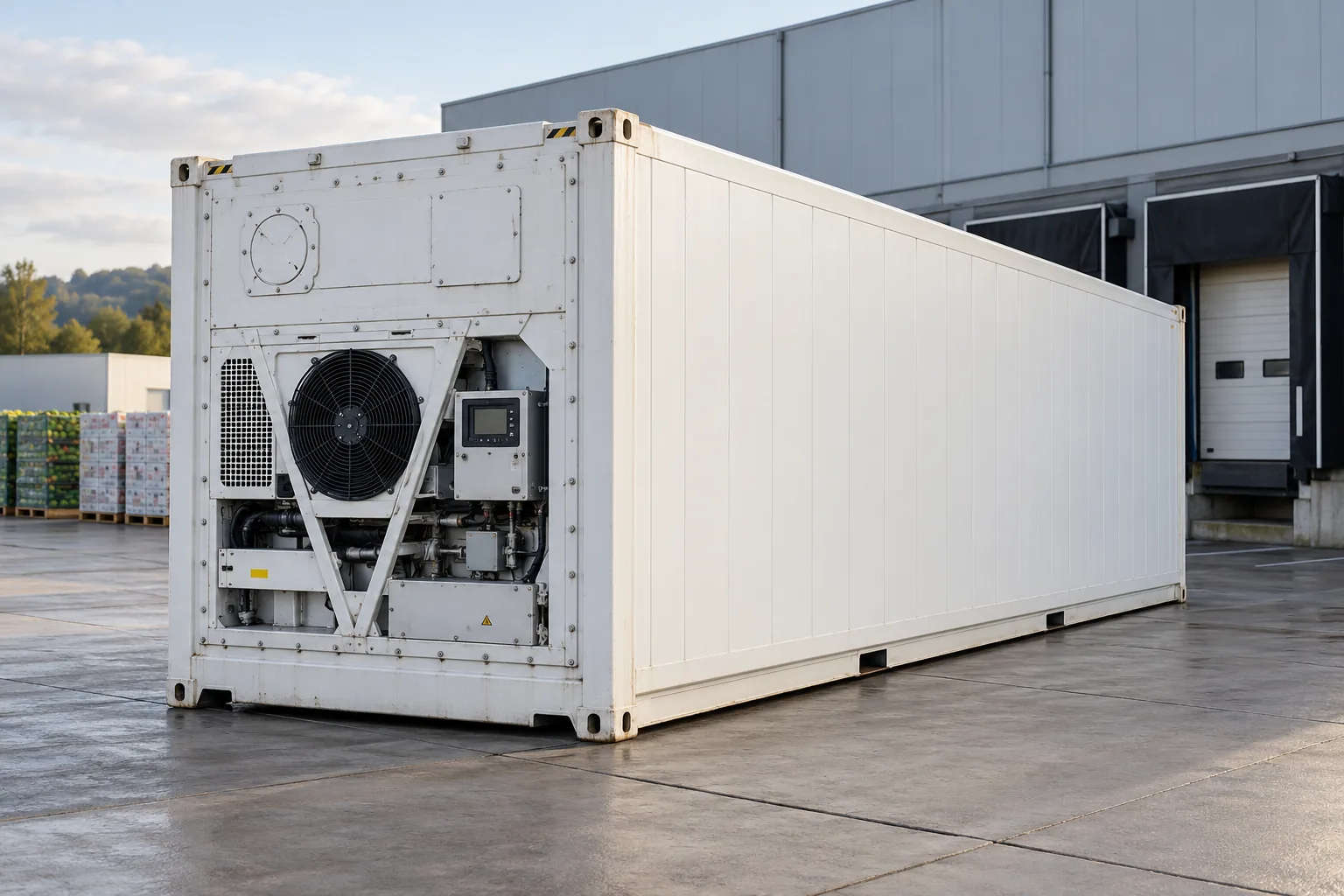
Refrigerated containers lose usable space to insulated walls and machinery. A dry-container drawing is not a reliable loading plan. Ask for the quoted model’s internal dimensions, clear door opening, permitted loading height, floor limits and access layout.
For scale, Hapag-Lloyd publishes a 20ft reefer fleet example with an interior of 17ft 10½in × 7ft 5¾in × 7ft 1in (17 ft 10.6 in × 7 ft 5.8 in × 7 ft 1 in), and a door opening of 7ft 6⅛in × 7ft 5⅛in (7 ft 6.2 in × 7 ft 5.1 in). These measurements describe that fleet example, not every 20ft refrigerated container. Obtain the allocated unit’s specification, including the usable loading envelope and the loaded height of your pallet or cart.
Goods and packaging must allow the unit’s designed air circulation. Keep the marked load limits and the supplier’s required clearances clear; physical ceiling height is not necessarily usable loading height. A geometrical pallet fit does not prove adequate airflow, floor capacity or safe handling.
| Measurement or limit | Why it matters | Evidence to request |
|---|---|---|
| Internal floor and door opening | Pallets, carts and handling equipment must fit | Dimensioned drawing of the actual model |
| Marked loading height and airflow paths | Air must reach and return around the load | Supplier loading layout and operating instructions |
| Floor and total load limits | Concentrated loads and handling equipment need assessment | Permitted loading and handling specification |
| Machinery and service clearances | Condenser airflow and maintenance access need space | Required clearances for the proposed site |
Confirm the electrical supply before delivery
Supply requirements vary by refrigeration model and installation. Obtain the actual nameplate and connection schedule before reserving equipment. A three-phase reefer cannot be assumed to operate from a standard household receptacle, and a transformer or generator option needs its own compatible specification. A quoted voltage or advertised current is not a wiring design. Have the supplier identify startup requirements and all supplied cables or accessories.
Have the supplier and a qualified electrical contractor check voltage, frequency, phase, current, protection, connector, cable route and isolation against the available site service. OSHA’s NRTL program covers testing and certification of certain workplace electrical products; confirm the equipment’s applicable approval and the local electrical permit or inspection requirements. A foreign-market mark alone does not resolve US acceptance. Agree who makes the connection, verifies operation and records commissioning.
- Exact model and electrical connection specification.
- Available site supply and the distance to the proposed container position.
- Responsibility for connection, commissioning and any required site work.
- A practical response to a power failure, including any suitable backup arrangement.
Ask for energy evidence under comparable conditions
Power in kilowatts (kW) describes the rate of electrical use at a point in time. Energy in kilowatt-hours (kWh) describes consumption over a period. Multiplying a nameplate rating by 24 does not establish typical daily consumption: operation changes with ambient temperature, setpoint, load, door openings and the equipment.
Ask for measured or documented consumption with its test conditions. Once installed, an appropriate meter reading at the start and end of a representative period can show consumption for that period. Record operating conditions alongside it; a quiet empty day is not evidence for a busy fully loaded week.
For a single confirmed energy rate, multiply measured kWh by the price in US dollars per kWh; 15 cents/kWh is US$0.15/kWh. Time-of-use or tiered rates require a calculation matched to the applicable usage periods or tiers. Business bills can also include demand charges based on peak kW, basic charges and taxes. Obtain these separately; a kWh estimate alone cannot calculate a peak-demand charge. Do not treat another site’s daily cost as a quote for your operation.
Compare quotes with a complete cold-storage duty
Capacity alone can hide a mismatch. An offer with shelving and frequent staff access may solve a different problem from dense pallet storage. Identify the clear route needed for people or handling equipment, the maximum load, and the stock that must remain accessible. Ask the supplier to validate its layout against the unit’s airflow and permitted loading.
For example, a hypothetical brief might ask for chilled packaged ingredients arriving at their specified storage temperature, daily deliveries, several door openings each hour during a shift and a weekend with few visits. A second brief might require reducing the temperature of a large newly delivered batch. Do not use one price or energy observation for both without having the supplier assess the different duty.
Request a written schedule dividing supplier work and site work: transport, unloading, supports, connection, commissioning, controls, monitoring, cleaning, service and pickup. A phrase such as 'ready to use' does not allocate each responsibility. Confirm when rental starts, any minimum term and whether setup days are billable.
| Include in the same quote scope | Ask the supplier to confirm |
|---|---|
| Storage and loading duty | Product range, entry temperature, access routine and validated usable layout |
| Site and connection | Delivery method, positioning, electrical specification and responsibility for site work |
| Operation and evidence | Handover, controls, temperature records, alarm recipients and energy evidence |
| Service and end of rental | Response commitment, exclusions, cleaning, notice to end the rental and pickup cost |
Agree the handover and breakdown response
Confirm the site position, ground requirements, unloading method and service access with the supplier. Before staff enter, verify a safe means of opening the door from inside and exiting, lighting, communication and emergency arrangements. Assess cold exposure, slips, refrigerant leaks and any atmosphere affected by the load or work. Shipping containers can be confined spaces depending on their configuration and hazards; have a competent person assess the applicable workplace rules before entry. An ordinary cargo door is not evidence of a safe walk-in cold store.
Ask who checks operation, sets the controls and trains staff in loading, cleaning, alarms and emergency release. Federal OSHA requires employees to be able to open an exit-route door from inside without keys, tools or special knowledge. Confirm whether federal OSHA or an OSHA-approved State Plan covers this workplace, and have the review establish the applicable exit, entrapment and emergency arrangements for this unit and use. Test the agreed release and alarm functions during delivery acceptance with the responsible supplier.
A telephone line advertised as available 24/7 does not necessarily promise a particular repair time or compensation for lost stock. Ask for response terms, maintenance responsibilities, alarm routing and the action to take if temperature moves outside the agreed limits. Establish who can move the goods and where they can go.
Send the same operating brief to each supplier
Include the product and duty, required capacity, model or minimum clear dimensions, ZIP code, dates, available power and access constraints. Request itemized rental or purchase, delivery, unloading, pickup where applicable, installation and monitoring or service charges. Confirm the sales tax basis and exclusions.
Keep the number of containers separate from the number of pallets you store. If the supplier proposes a different size or modular cold room, request a revised layout and electrical specification before comparing the offer.
Questions before you choose
Can a refrigerated container run from a normal socket?
Do not assume so. Reefer specifications can require industrial three-phase power. Check the allocated unit’s nameplate, voltage, phase, frequency and approved connection arrangement with the supplier and a qualified electrical contractor before delivery.
How much electricity does a refrigerated container use?
There is no reliable universal daily figure. Ask for model-specific evidence showing the setpoint, ambient temperature and operating conditions, then measure a representative period at your site where appropriate.
Can I fill it right up to the roof?
Follow the marked load line and the manufacturer’s loading instructions. Air circulation and the return-air route can require clearances below the ceiling and around the stock. Nominal cubic capacity is not fully usable storage space.
Will a standard reefer freeze warm goods quickly?
Do not assume so. Holding stock at a temperature and rapidly bringing warm products down to that temperature are different duties. Have the supplier validate the required cooling or freezing task before ordering.