External dimensions
6,058 × 2,438 × 2,591 mm
Length × width × height, rounded. Also allow space for the doors and delivery.
Purchase · New & used
Compare new, one-trip and used 20-foot shipping containers. Check dimensions and condition, then request a total including GST, delivery and unloading to your postcode.
Dimensions: 6,058 × 2,438 × 2,591 mm external and 5,900 × 2,352 × 2,395 mm internal on the example model (length × width × height), i.e. approximately 13.9 m² of internal floor area and 33.2 m³. See the table
20ft prices: Request an Australian-dollar quote for the actual unit, applicable GST, delivery and unloading to your postcode. See prices and models
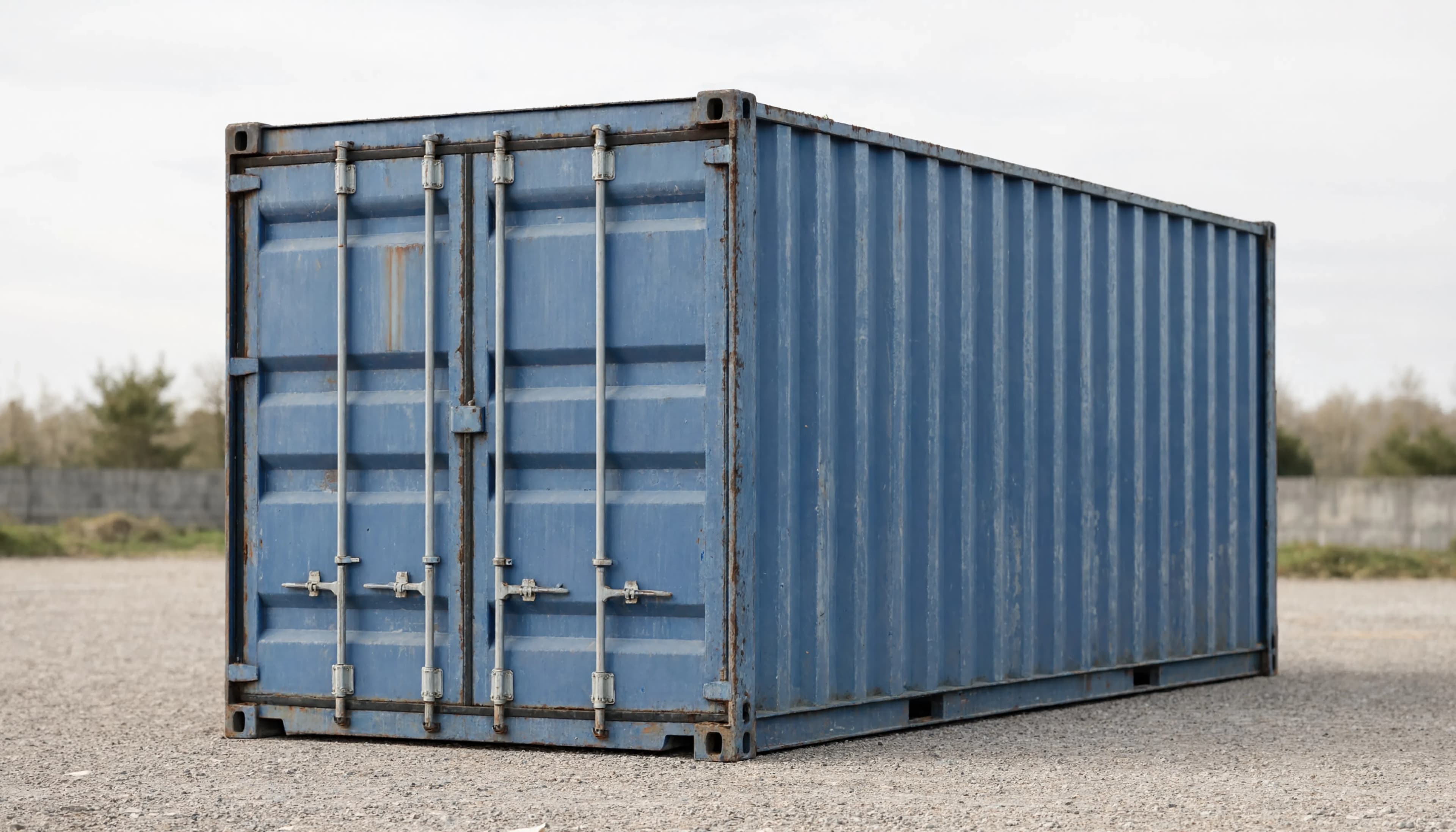
Compare the delivered price to your site.
The departure depot and unloading method affect the total. A single request allows you to compare offers on the same basis.
To work out whether it is suitable, check the external footprint, the space inside, the door opening and the weight to be handled. The figures below relate to a standard 20ft container, also called a DRY container. The external dimensions are those of the standardised format; the internal dimensions, doors and weights describe one example model per column.
| Reference | 20ft standard (dry) | 20ft High Cube |
|---|---|---|
| External length | 6.058 m | 6,096 mm |
| External width | 2.438 m | 2,438.4 mm |
| External height | 2.591 m | 2,895.6 mm |
| Internal length | 5.900 m | 5,918.2 mm |
| Internal width | 2.352 m | 2,336.8 mm |
| Internal height | 2.395 m | 2,692.4 mm |
| Door opening width | 2.340 m | 2,336.8 mm |
| Door opening height | 2.292 m | 2,565.4 mm |
| Stated internal volume | 33.2 m³ | Not published: available on request |
| Calculated internal floor area | Approximately 13.9 m² | 13.83 m² (calculated) |
| Tare weight | 2,350 kg | 2,320 kg |
| Maximum payload | 28,130 kg | 28,161 kg |
| Maximum gross mass | 30,480 kg | Not published: available on request |
Standard: international fleet reference dimensions. High Cube: one manufacturer specification, checked on . Its exterior length is nominal and its imperial measurements are rounded. Confirm actual unit dimensions, capacity and availability before ordering.
Gross weight: The maximum gross mass published for the table example is 30 480 kg. Use the actual unit's current markings, CSC plate and inspection status for its container rating; a generic ISO-series figure is not permission to load to that mass. The load also has to satisfy floor and concentrated-load limits, handling equipment ratings and the carrier's road, axle and route restrictions. A container's gross rating is not the allowable gross weight of the truck and trailer.
6,058 × 2,438 × 2,591 mm
Length × width × height, rounded. Also allow space for the doors and delivery.
5,900 × 2,352 × 2,395 mm
Length × width × height on the example model. Internal measurements vary by manufacturer.
≈ 13.9 m² · 33.2 m³
Calculated internal floor area and stated internal volume for the example model. Shelving, securing and walkways reduce the space available for your goods.
≈ 2,340 × 2,292 mm
Width × height on the example model. Measure your load and confirm the clearance on the unit offered.
Standard: approximately 33.2 m³To consider if the volume and door height are sufficient for your equipment.
High Cube: extra heightCompare the published door opening and finished interior. Ask for the volume of the actual unit.
40ft: 12.192 m longTo consider if the 20ft is too short or too small. Check the available space for delivery.
High Cube: the reference sheet does not state its internal volume. Confirm usable capacity, openings and load ratings for the unit offered.
The illustrated calculation fits 10 nominal 1,165 × 1,165 mm pallets on this reference floor in one layer. It uses 1,219.2 × 1,016 mm footprints with no overhang, aisle, handling or securing allowance. Rotated pallets need compatible fork entry and a workable loading sequence. Verify the actual loaded dimensions, door clearance, floor loads and carrier requirements; this is not a guaranteed capacity.
Adjust the allowances or compare Euro pallets in the pallet planner.
The standard interior, doors, volume and weights belong to one international carrier fleet example. The external dimensions use a separate equipment-provider reference, 6,058 × 2,438 × 2,591 mm; no other measurements from that reference are mixed into the interior or mass figures. Actual specifications vary by manufacturer.
The standard internal floor area is 5.900 m × 2.352 m = 13.8768 m², rounded to 13.9 m². This geometric area does not deduct aisles, racking or fittings.
The 20ft High Cube reference uses one manufacturer specification, checked on . Its published feet/inches and pounds are converted with exact unit factors; this does not make the rounded source measurements a survey of the unit offered. Floor area is calculated from the published interior. Internal volume and maximum gross mass are not stated on this sheet: obtain them for the actual unit, together with current plate and inspection information.
| Obstacle | What it is | What to bear in mind |
|---|---|---|
| Corner posts and corner castings | Corner posts and corner fittings can intrude into the loading space | The usable volume is not a cuboid: the corners are taken up |
| Lashing rings and lashing bars | Securing points and fittings vary by container construction | Check their location, condition and permitted loads before planning cargo securing |
| Door sill | The threshold profile and height depend on the unit | Measure the threshold and clear door opening; internal height alone does not establish loading access |
| Floor | Floor materials, thickness, crossmembers and permitted loads depend on the unit | The stated height is measured above the finished floor |
| Wall corrugation | Corrugated walls and local reinforcements affect the clear space | Ask for the minimum clear width and local obstructions at the height needed by your load |
These are features to inspect, not universal construction dimensions. ISO 1496-1 covers general cargo container specifications and testing; obtain the actual unit’s drawings and loading limits before a loading or conversion design.
The delivered total depends on the size, condition, depot, transport, unloading and any conversion work. Our Australian catalogue lists 19 model specifications for individual quotations. Ask for conversion and site installation to be priced separately. Request an itemised quotation including GST, transport, unloading and every mandatory charge.
Same nominal length, different height, access or condition: compare the specifications before requesting an Australian-dollar quotation. Availability and delivery are confirmed for your location.
Scroll to see all formats.
Scale
1.75 m
length 2.972 m height 2.591 m
20ft standardthis page
length 6.058 m height 2.591 m
length 6.096 m height 2.896 m
length 12.192 m height 2.591 m
length 12.192 m height 2.896 m
Ext. height 2.896 m
Same footprint, greater height. Useful if your equipment is taller than the standard door.
Side opening ≈ 5.715 m · ≈ 30.7 m³
Load access via the long side. The clear opening height must be requested.
Same dimensions as standard · condition to be checked
Usually marketed after one loaded journey from manufacture. Confirm the unit's history; handling marks may remain.
Same dimensions · condition varies by unit
Watertightness, floor, doors and repairs: what to check before buying.
Insulation and openings reduce the usable space
Office, workshop or premises: the conversion work is priced separately from the container.
For rental
Refrigeration unit · connection required
For perishable goods or sensitive products. Power, maintenance and return are to be detailed.
External length 2.972 m · approx. 16 m³
About half the length of a 20ft container, for a limited space.
External length 12.192 m · approx. 67.7 m³
Approximately twice the length. Check the space for delivering a large container.
All sizes and their uses: the shipping container guide.
Start from your intended use and the acceptable level of wear. The photos of the container on offer matter as much as its trade name.
To prioritise budget
To consider for storing equipment if signs of use are acceptable. Ask for details on watertightness, the condition of the floor, doors and repairs.
Ask for: recent photos of the unit offered.
To prioritise condition and appearance
Marketed as new after its first journey from manufacture. It may show handling marks: ask to confirm the colour, condition and included fittings.
Ask for: photos and the specification of the model sold.
Ask for photos of the interior, floor, doors and markings, as well as the collection location. Check the seller’s identity and the condition of the unit. Add transport and unloading to your budget if they still need to be arranged.
| Warning sign | What to check | What to ask for |
|---|---|---|
| No photos of the inside or the roof | The roof, walls and floor still need to be checked | Dated photos of the inside with doors closed, and of the roof |
| No readable container number | Missing or repainted identification makes it harder to match the unit to its records; check the seller’s right to sell separately | The full code and matching records; the check digit detects transcription errors, not ownership |
| CSC plate or current examination details missing | CSC concerns international container transport. Static storage still needs separate checks for siting, handling, condition and intended use | Legible plate details and applicable examination records; confirm acceptance with the carrier |
| Price well below market value | Check the condition, seller and omitted charges; a low price alone does not establish fraud | Verify the seller, actual unit and written terms before paying; consider an independent inspection and payment protection |
| Refusal to allow a viewing | Prevents you from checking the container before paying | An on-site appointment before payment |
| Transport “at your expense” without specified access | Clarify who arranges transport, the collection and delivery access, and who receives each payment | The collection address and an itemised written delivery agreement, whether arranged by you or the seller |
For international transport, confirm CSC approval and current examination arrangements with the owner and carrier. For an Australian purchase, identify the actual business and written terms; Australian Consumer Law may apply to business sales and eligible purchases. A private sale has a different legal scope. Verify authority to sell, unit identity, condition and payment details independently. An online listing or CSC plate does not prove ownership.
The items to be stored and how often you need access will help you choose the equipment that will genuinely be useful.
CASE 1
Furniture, boxes and garden tools can stay close to the house during a renovation or a move. Leave an access aisle, distribute loads appropriately and check floor loading for heavy items. Have the truck access and ground checked before ordering.
Equipment to consider
Pallets or duckboards on the floor, shelving, moisture absorbers and a suitable padlock.
CASE 2
Tools, consumables and small machines stay on site, locked up in the evening. Place the container out of the way of plant and where the truck can collect it again. Depending on the length of the site, compare buying and renting.
Equipment to consider
Sturdy shelving, wall hooks, reinforced locking and self-contained lighting.
CASE 3
Seasonal stock, packaging, furniture or event equipment free up the back of the shop. Sort items by how often they are taken out and keep fast-moving items near the doors. Watch humidity if you store cardboard boxes or textiles.
Equipment to consider
Labelled shelving, a ramp for a sack truck or pallet truck, ventilation or dehumidification depending on the contents.
CASE 4
Workshop, office or technical room: insulation, openings and services should be decided before purchase, as they reduce usable space. Get the work quoted separately. Confirm municipal zoning and development requirements and the applicable state or local building, fire and electrical approvals before installation.
Equipment to consider
Insulation, door and window openings, electrical installation, ventilation and floor covering.
A workshop, office or premises? Plan a container conversion project.
The postcode locates your project. The access conditions then allow the supplier to propose suitable transport and unloading.
Specify the town, the installation site and your flexibility on the date.
Report the gate width, bends, slopes and overhead obstructions.
Give the distance between where the truck can park and the planned location. A few photos help to prepare for delivery.
State whether you have suitable equipment on site or whether it should be arranged by the seller. Have the supports and ground preparation checked.
The supports and ground must carry the loaded unit and allow the doors to operate. Ask the supplier and, where needed, a qualified local designer to assess soil bearing, drainage, frost movement, support positions and anchoring. Arrange snow clearing and check seasonal access restrictions where relevant. Check local container siting and permit rules before installation.
External footprint of a 20ft: approximately 14.8 m². This is a dimensional estimate, not a permission threshold.
Before delivery, give council the location, intended use, position, height, duration, supports, utilities and access plan. Confirm planning controls and building approval separately, along with plumbing, wastewater and public-road permissions where relevant. Check bushfire, flood and wind or cyclone exposure. A small footprint, mobility, short hire period or CSC plate does not establish an exemption across Australia.
Ask council whether the residential use is permitted. Establish the development application, complying development or other pathway, zoning and site constraints. Container size does not establish eligibility. Agree certification, construction and occupation requirements with the certifier. Check applicable NSW provisions, including BASIX where relevant.
Official guidanceCheck the planning scheme, proposed residential use and overlays with council. A planning permit and a building permit serve separate purposes. Appoint the relevant building surveyor and establish building permit, inspections and completion or occupancy requirements. Planning guidance for commercial container stacks does not approve a home.
Official guidanceCheck the council planning scheme, intended use, siting, services and overlays. A council's temporary-storage conditions cannot be transferred to other land or to residential use. Discuss building development approval, classification, plumbing and inspections with the certifier and council. Resolve supports and anchorage before fabrication.
Official guidanceAsk the local government about the current planning scheme, R-Codes where applicable, local container policy and proposed residential use. Confirm development approval separately. Establish the certified or uncertified building permit pathway, building surveyor's evidence and completion requirements with the local government permit authority.
Official guidanceUse PlanSA and the relevant authority to establish planning consent under the Planning and Design Code. Land use, overlays and proposed services affect the assessment. Establish building consent and obtain full development approval before starting work. Planning consent alone is not full development approval. Agree completion and occupancy requirements.
Official guidanceConfirm planning requirements with council before ordering. A low-risk or notifiable building category does not establish a planning exemption. Ask the building surveyor and council permit authority to classify the actual work under the Director's Determination. Low-risk, notifiable and permit work follow different processes; confirm inspections and completion documents.
Official guidanceCheck development approval with the territory planning authority. An exemption from development approval does not automatically exempt the building work. Appoint a building certifier and establish building approval, commencement, inspections and completion requirements. Any claimed exemption must meet its specific criteria and general conditions.
Official guidanceConfirm the land-use and development consent pathway with the relevant planning authority, including outside building control areas. Remote land arrangements need their own assessment. In building control areas, establish the building permit and completion or occupancy process with the certifier. Outside those areas, check remaining planning, servicing, contractual and safety responsibilities; do not assume unrestricted residential use.
Official guidance| Measure | How it works | Its limitation |
|---|---|---|
| High and low level ventilation grilles | Ventilation can exchange moist internal air with outside air, depending on openings, wind and temperature differences | Outdoor air whose dew point exceeds the temperature of the cargo or container surfaces can cause condensation. Added vents do not guarantee dry storage in a hot, humid climate |
| Moisture absorbers | Desiccants absorb moisture up to a limited capacity; follow the manufacturer’s positioning and handling instructions | Ask the desiccant supplier to size the product for the goods, moisture load, storage period and ventilation, and specify inspection and replacement intervals |
| Insulation | A correctly designed insulation system can help control surface temperatures and condensation risk; insulation alone does not guarantee dry conditions | For occupied conversions, coordinate insulation, air leakage, vapor control and ventilation; have the designer assess condensation in the proposed assembly |
| Protection for moisture-sensitive goods | Suitable packaging or covers may reduce damage from droplets; specify protection for the goods and storage conditions | Covers do not remove moisture and can trap it. Avoid relying on loose paper or film as the sole condensation control |
These are planning considerations, not a guarantee of dry storage or a building specification. Assess moisture in the goods, temperature changes, ventilation and the actual use before selecting controls.
| Device | Protects against | Its limitation |
|---|---|---|
| Shackle protector | Masks the padlock shackle: bolt cutters, angle grinder, lever | Check what the product's test or certification covers; a lock rating does not establish the resistance of the whole container |
| Anti-break-in bar | Against levering: it clamps the locking rods of both doors | Ask how the locking bar, its fixings and the container doors have been assessed together; do not infer whole-container resistance from a lock rating |
| Alarm | Ask for the actual alarm model, intended environment, power supply and communication method | Ask the installer to confirm the environmental class, operating temperature and suitability for an unheated container and any exposed components |
Check the resistance of the whole assembly: doors, fittings, lock and protections. A commercial security designation does not establish a resistance level
Compare your 20ft container delivered and unloaded.
Size, condition and postcode: prepare a single request to compare the container, its transport and unloading. Free and without obligation.
Step 1
Container type, condition, purchase or rental and quantity.
Step 2
Your requirements and postcode, entered only once.
Step 3
Container, transport and unloading, on the same basis.
Free and with no obligation. The supplier directory does not sell containers. Your request goes through our comparison service: the companies listed in the directory are not necessarily the recipients of your request. Professionals may pay for the introduction service (How the service works).
Prepare my requestThis selection reproduces the information published by the companies in the directory. Directory order, not a ranking; it does not guarantee stock or receipt of your request.
35 businesses whose published information mentions : 20ft · Sale
1300SPAREBOX
20ft · Sale
View the offer and listingABC Container Hire & Sales
20ft · Sale
View the offer and listingABC Containers (WA)
20ft · Sale
View the offer and listingAdelaide Shipping Containers
20ft · Sale
View the offer and listingBetta Storage Containers
20ft · Sale
View the offer and listingBudget Shipping Containers
20ft · Sale
View the offer and listingUpdated on · Dimensions and weights describe the cited reference models, not a reserved unit. Australian prices, stock, applicable taxes, delivery and unloading are confirmed by quotation for your postcode.
Check these details before comparing equipment, delivery and services.
Free · No obligation