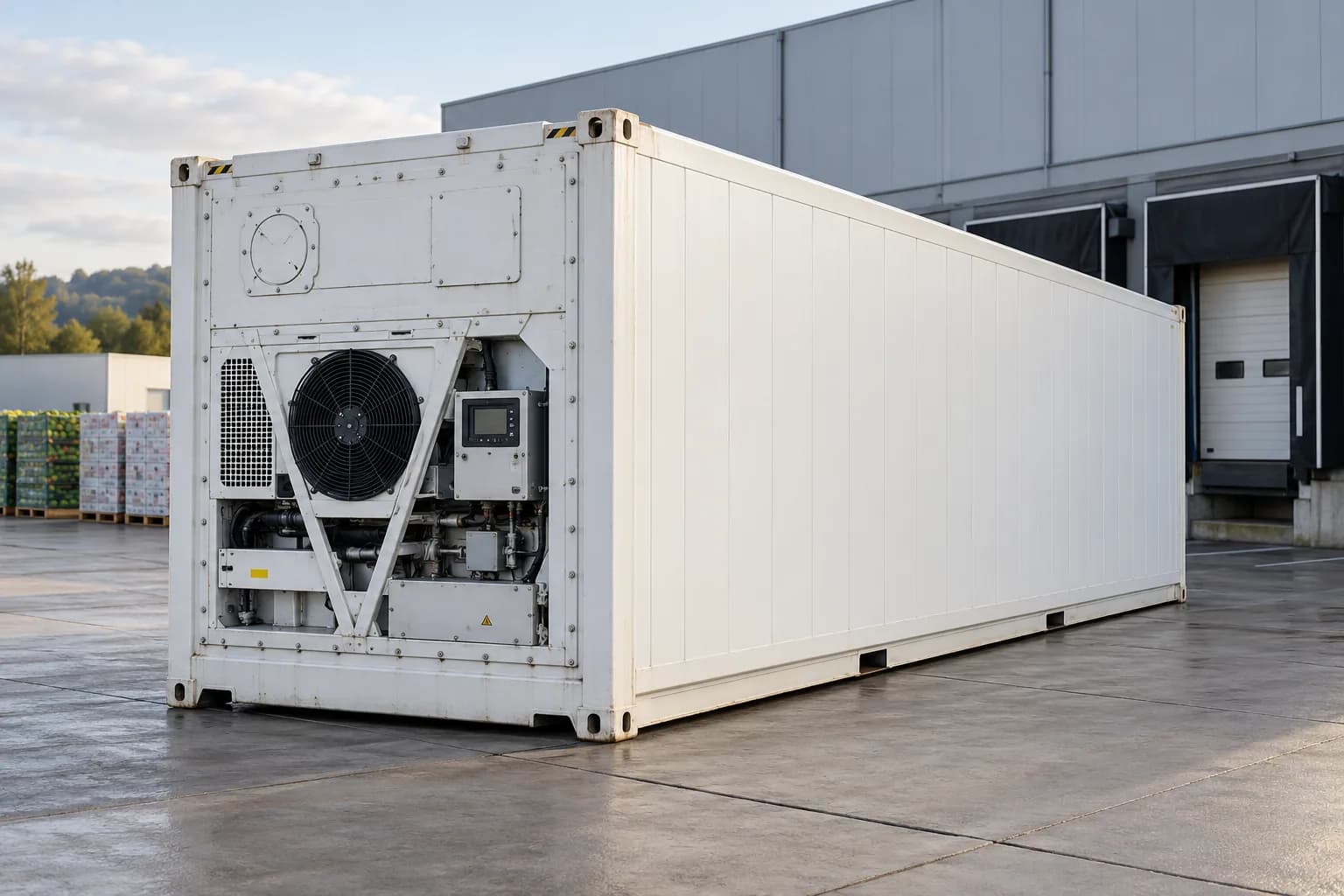
Start with the goods or activity you need to protect. Australian suppliers offer insulated conversions and non-operating reefers as well as powered refrigerated units. Specify the construction and the actual use before comparing quotes: insulation alone does not maintain a guaranteed temperature.
Generated illustration, not a supplier’s available unit.
Four specifications to compare
Insulated-container options and checks for the proposed unit
Option
What it means
Check in the quote
Insulated dry-container conversion
A dry shell with an added insulation and lining system.
Insulated surfaces, finished dimensions, doors, moisture design and electrical work included in the specification.
Non-operating reefer (NOR)
A former refrigerated container used as an insulated enclosure without working refrigeration.
Panel, door-seal and floor condition; cooling machinery retained or removed; repairs and the actual door opening.
Insulated unit with air conditioning
An insulated enclosure with specified heating or air conditioning for its intended use.
Design conditions, ventilation, electrical supply and commissioning. Comfort cooling is a different duty from refrigerated food storage.
Operating refrigerated container
A powered refrigeration system for a specified cold-storage duty.
Required temperatures, loading, power, monitoring, maintenance and breakdown arrangements.
A NOR has no active cooling. Give the supplier the contents, acceptable temperatures, loading pattern, door-opening frequency and expected ambient conditions. If controlled cold storage is required, compare an operating reefer and its services instead of relying on passive insulation.
For a food business, define the required food temperatures and monitoring with the responsible food-safety person. A lined container or a cool-feeling interior is not proof that food is being stored safely. FSANZ explains food temperature control.
Australian suppliers with published product information
These official product pages establish advertised equipment types. They do not confirm stock, a loading address or delivery availability for your postcode.
Royal Wolf
Publishes non-operating refrigerated containers as insulated storage without active cooling. Ask the branch serving your postcode to confirm the unit, hire or purchase terms and delivery.
Product page reviewed . Ask for the unit’s current condition and offer.
ContainerSpace
Its Melbourne sales page lists 20ft and 40ft reefers in operating and non-operating versions. The non-operating option has no working refrigeration machinery; confirm the exact unit and its internal dimensions.
Product page reviewed . Ask for the unit’s current condition and offer.
20ft or 40ft: use the finished dimensions
20ft insulated container
Ask for completed internal length, width, height and door opening. Panels, linings and equipment reduce the room available for pallets, shelving or a work area.
40ft insulated container
Compare standard and high cube units using the proposed model’s drawings. Allow for truck access, placement, machinery access and full door operation.
A nominal 20ft or 40ft size is not a finished floor area. Use the insulation guide and usable-space tool to prepare planning inputs, then replace them with the proposed unit’s drawings and actual measurements.
Compare an itemised Australian delivered quote
01
The enclosure
Shell condition, insulation, linings, floor, door seals, personnel doors and any alterations.
02
Equipment and services
Heating or cooling, ventilation, electrical work, controls, inspection and commissioning for the specified duty.
03
Your postcode
Delivery, unloading, supports and connections. Ask for the currency in AUD and whether the quoted amounts include GST.
Confirm whether the price is for an insulated finished unit or a shell awaiting work. For hire, include the billing period, minimum term, servicing, extension and collection. No verified market-average price for completed insulated units is published here; ask for current quotes on the same specification.
ContainerFox helps prepare and compare requirements. The supplier must confirm its participation, equipment, availability and final contract terms for your project.
Moisture control and occupied use need their own specification
Ask how the assembly handles condensation, air leakage and thermal bridges at the steel frame, floor and doors. Agree which surfaces are insulated, how the lining protects the material and how inspection or repairs can be carried out. Storage, food handling and an occupied office need different specifications.
For an office or home project, provide the responsible authority or building surveyor with the proposed location, use, dates and installation. Existing reefer insulation does not establish approval for an occupied building. Keep the shell purchase, design, installation and approvals as explicit parts of your project brief.
A standard dry steel shell is not a finished insulated enclosure. Specify added insulation, linings and floor treatment. A reefer has different construction; check its condition and whether the refrigeration works.
Does a non-operating reefer keep goods cold without power?
Insulation slows heat transfer, but a non-operating reefer has no working refrigeration to remove heat. It does not guarantee a storage temperature. State the goods and conditions so the supplier can propose suitable equipment.
Can I hire an insulated container in Australia?
Royal Wolf publishes non-operating insulated storage and offers hire or purchase enquiries. Availability, equipment and the branch serving your postcode must be confirmed for the project; the guide is not a stock listing.
Can an insulated container become an office or home?
It can be a starting point for a conversion enquiry. Request condition assessment, structural and building design, intended-use specifications and the relevant approvals. Existing insulation alone does not validate a completed building.